While I have been based in El Bolson for well over a year now, I missed last year's transition from Winter to Spring for a trip to the States. I experienced the transition this year and it was moving. It started and accelerated subtly, with rainy days petering out and giving way to sunny ones and then sunnier ones. The first flowers were a few scattered periwinkles, then plum trees, narcissus, and then the willows and elders started to send out green shoots. The wasps and bumble bees started to putter around and then the honey bees got to work. The grass started growing faster and took on a more lively shade of green. In a matter of several days all seemed to turn from something that isn't quite misery or drudgery but its not so great either to something more akin to hope and cheer. The odor of flowers thrown around by the strong, cold winds. Hummingbirds. Less cool birds returning from Winter trips, making an unholy racket all night as they catch up on old times. But that's fine that they make so much noise.
First and foremost I noticed the end to consistent and overnight frosts. I could lift my head and see clearly out the window, free as it were of frozen condensation. And I could get up and go to the kitchen without a sinking feeling that the water pipes had frozen. Most importantly I could get out of bed earlier with a desire to do something other than sit by the stove and eat. Like plant the first crops of the Spring, peas and fava beans. And build a little box to plant Tomatos in, because they need to be inside still to guard from the occasional frost, like the one that came on the one night I forgot to bring them inside. And they died. But its ok because I'll just buy little plants this year and do better next time.
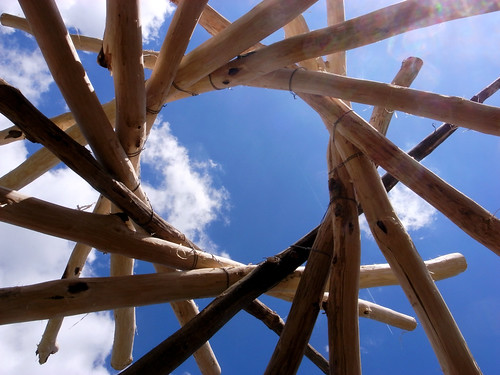
Nature's waking up and getting in gear is mirrored in my life. I got my first paid job here, working on an extension to the house I was taking care of this winter. The extension will be a large "winter garden" eating and sitting area. I'm working with a great carpenter who runs in the same natural construction circle as I do. We are doing the structure with round timber and will be installing a "living" roof covered in grass. I am getting great first-hand construction experience and have been invited to work on coming jobs this summer which will include work with various forms of adobe walls and natural, clay-based finishes.
I have also resolved for the time being my living situation and been given the chance to realize my dream of building my house. A friend of mine is lending me use of his land on the farm where I lived last summer. The idea is that I will build a small house and have the right to make my home there at least for the next several years, but that in some future the house will remain for his use. It's an unwritten arrangement between friends and is convenient for both of us. I'm finalizing the designs, but it will be a circle about 15 feet in diameter with some combination of straw bale and adobe walls, a mini greenhouse built into one wall, a high-efficiency wood stove that heats an adobe bed, and a living, "reciprocal" roof. While I'll have limited access to internet this summer, I plan to write extensively about the whole process, which in reality already began when we marked the site and start clearing out the invasive rose-hip bushes.
My plan is to set up camp on the building site in a yurt. Yurts are the tents of mongolian nomads, but mine will be made by these guys. I'm in the process of building an octagonal deck on which to put the yurt so it stays off wet ground and to give it a more homey feel inside. The yurt will be about 17 ft in diameter with a wooden door and a chimney to allow for a wood-stove, so although it is easily transportable it's more like a cabin than a tent. Having this base will allow me to approach the house-building with more comfort and less anxiety. After living for almost two years in other people's homes, this private refuge will be welcome.
In addition to building my house and building other people's houses, I'll be working with a group of friends to host a huge sustainable living workshop called "Bioconstruyendo" in February of 2011. In the months leading up to the workshop we'll be preparing to host an estimated 200 people for a week of courses on building, farming, and alternative energy.
The other exciting project in my life is my violin. I'm taking a course on instrument making with a local instrument maker and building my own violin. So far I have glued together the boards for the top, cut out the form and begun to carve out the inside. It looks kinda like a violin. My plan is to chronicle the process, which I expect to take several more months, quite thoroughly, so I'll write about it another time.
That's the skinny for now. If you are reading this I'd love to hear from you.
Tuesday, October 19, 2010
Saturday, July 24, 2010
Winter in Patagonia: Motorcycle Diaries
I recently bought a motorcycle. A 1993 Suzuki TS125. For those of you that don't know motorcycles, its an "enduro" bike, which means it's a sort of street-legal motorcross bike. I know, it's a step away from my professed goal of granola self-sufficiency, but I decided that, to really take advantage of this place, I need to be more mobile. I'm going to classes on beekeeping, medicinal plants, and tai chi, starting a nursery with a group of friends, and even scored a small gardening job recently. I need to be able to get around more easily to make all this work, and the bike consumes less than a car. I must admit that I am hooked, so hopefully someone is working on the used cooking oil version.
Despite my enthusiasm for the two-wheeler, I am not quite a Hell's Angel yet...
For starters, most people would say that someone of my size needs a bigger bike. Well, I looked at some bigger bikes and they scared the crap out of me. This bike is fine, though. Struggles on the steep hills, but the little engine that could always makes it up.
I had never driven a motorcycle before, so buying one inevitably led to the mildly embarrassing moment when the young mechanic offered me a test drive. It spit and sputtered and stopped and screamed around the block under my mediocre management of pedal and throttle and clutch. "You'll get it in no time, " he cleverly assured me.
A couple days later I stopped at a gas station to get an empanada. When I walked out to the bike I realized I had neither my helmet nor my key. I smiled sheepishly as I turned to find the cashier bringing them out to me.
I did get it, but over the next few days I made it scream and shut-off a fair amount, sometimes in the middle of what is thankfully light traffic. One night in the rain I thought it was broken because every time I put it in first it shut off. A little throttle was all I was missing, I realized as a friend got it going with no problems.
The first time I tried to take it up a big hill, the big hill that is an elemental part of the route between my house and the town, I stalled halfway up. I cursed myself as I struggled in the freezing cold to start it without rolling down the hill or falling over. That only happens occasionally now. Almost never.
One day I had stopped by the side of the road to look at something and I lost my balance and the bike just fell over. Thankfully I didn't fall and nobody was around to see. Frantic only with embarrassment, I inefficiently struggled until the bike was upright again. That was, to be clear, a one time occurrence on day 3 of ownership.
Speaking of ownership, I'm not even really clear on my status. I have the title and a bill saying I bought and paid for it, but I have no license plate and no registration and no insurance. In short, I'm not sure that if I get stopped they won't just take it away from me. Thankfully my area of circulation is limited and largely rural, police presence is near non-noticeable here, and I wear a helmet and have working lights. People, and by people I mainly mean the guy who sold me the bike, say that lots of people here roll like that and that as long as I keep between the lines I'll be ok. So far so good.
The turn blinkers don't automatically turn off as they do in all cars I have driven, so I often drive all over town with a blinker on before realizing it. They are also wired wrong so I have to think left to turn right and vice versa.
Temperatures hover around freezing here on most days, and with the wind rushing by it can be painful. One morning I had to stop into a gas station and just go stand inside after only a few minutes of riding. I couldn't even get my helmet off my fingers were so numb. I realized my gloves were not enough, so I bought these handlebar covers that look like oversized cooking mittens. For a while it really bothered me that I couldn't see my hands. Not to mention that waving while driving is even more complicated than ever.
These struggles are behind me now, for the most part, and I'm on my way to being a true motorcycle man.
Despite my enthusiasm for the two-wheeler, I am not quite a Hell's Angel yet...
For starters, most people would say that someone of my size needs a bigger bike. Well, I looked at some bigger bikes and they scared the crap out of me. This bike is fine, though. Struggles on the steep hills, but the little engine that could always makes it up.
I had never driven a motorcycle before, so buying one inevitably led to the mildly embarrassing moment when the young mechanic offered me a test drive. It spit and sputtered and stopped and screamed around the block under my mediocre management of pedal and throttle and clutch. "You'll get it in no time, " he cleverly assured me.
A couple days later I stopped at a gas station to get an empanada. When I walked out to the bike I realized I had neither my helmet nor my key. I smiled sheepishly as I turned to find the cashier bringing them out to me.
I did get it, but over the next few days I made it scream and shut-off a fair amount, sometimes in the middle of what is thankfully light traffic. One night in the rain I thought it was broken because every time I put it in first it shut off. A little throttle was all I was missing, I realized as a friend got it going with no problems.
The first time I tried to take it up a big hill, the big hill that is an elemental part of the route between my house and the town, I stalled halfway up. I cursed myself as I struggled in the freezing cold to start it without rolling down the hill or falling over. That only happens occasionally now. Almost never.
One day I had stopped by the side of the road to look at something and I lost my balance and the bike just fell over. Thankfully I didn't fall and nobody was around to see. Frantic only with embarrassment, I inefficiently struggled until the bike was upright again. That was, to be clear, a one time occurrence on day 3 of ownership.
Speaking of ownership, I'm not even really clear on my status. I have the title and a bill saying I bought and paid for it, but I have no license plate and no registration and no insurance. In short, I'm not sure that if I get stopped they won't just take it away from me. Thankfully my area of circulation is limited and largely rural, police presence is near non-noticeable here, and I wear a helmet and have working lights. People, and by people I mainly mean the guy who sold me the bike, say that lots of people here roll like that and that as long as I keep between the lines I'll be ok. So far so good.
The turn blinkers don't automatically turn off as they do in all cars I have driven, so I often drive all over town with a blinker on before realizing it. They are also wired wrong so I have to think left to turn right and vice versa.
Temperatures hover around freezing here on most days, and with the wind rushing by it can be painful. One morning I had to stop into a gas station and just go stand inside after only a few minutes of riding. I couldn't even get my helmet off my fingers were so numb. I realized my gloves were not enough, so I bought these handlebar covers that look like oversized cooking mittens. For a while it really bothered me that I couldn't see my hands. Not to mention that waving while driving is even more complicated than ever.
These struggles are behind me now, for the most part, and I'm on my way to being a true motorcycle man.
Thursday, July 15, 2010
Winter in Patagonia: Bringin' the Heat
I’m spending the winter house-sitting outside of El Bolson. The house is near to the farm I lived at all summer and shares the stunning landscape of the valley of the Rio Azul. While life in the country is tranquil and beautiful, it is also a fair bit of work.
The biggest issue is heating. Temperatures are regularly well below freezing and my house is not well-insulated, which means I have to blast one or more of the three wood stoves (one is a “Russian” masonry heater, one is a wood-fired cooking stove, and one a water-heating tank) to provide comfort. Keeping these fires going requires lots of wood. In April, we worked on cutting and piling a stock of firewood in the forest behind the house, but retrieving it requires a trip up a considerable incline with a wheelbarrow. It takes less than five minutes to get up, but it’s a huffing five minutes of muddy or icy path, depending on the time of day. I have a frustrating propensity to try and pile as much as possible into the wheelbarrow. I then spend the downward trip stopping every few steps to pick up and repack what falls out. I am starting to learn to moderate my cargo, but the gamble is tempting.
I get the wood down and then I have to split it with the ax. Usually pretty easy and a welcome meditation, but once every batch I bury the ax head in a knot and have to either break my back to bust it out by brute force or surgically open it up with a chisel and hammer. I need to get this wood into the house, so I make several trips in and out, amassing stockpiles by each stove that give me great comfort in the moment despite the fact that I know they will later submit with terrifying ease and velocity to the flames.
I made a mess bringing that wood in, so I need to sweep up. As I sweep wood chips and dust teleport themselves from the dust pan to the place I just swept. I have learned to accept a measure of rustic mess, but, as it is not my house, I feel compelled to strive for cleanliness always.
Starting the fires is a whole ‘nother task. A cold chimney, result of said below-freezing temperatures, does not, what we in the fire-world like to call, “pull,” and thus a fire is prone to die until its pathway out is heated up. Add to cold chimneys humid wood and prospects are less than ideal. I persist and succeed and I have tricks and techniques, but every now and then, despite best intentions and preparations, I encounter a smoky, resistant bastard like the one I encountered this morning. I burned dozens of grade-school homework sheets and filled the house with toxic smoke before my teary, burning eyes saw sustained flamery.
I start to read, write, enjoy my breakfast, but every time I settle into my chair I realize that if I forget to keep putting logs in, I will lose the fire and all my invested time and lung cells, so I return dutifully to the beast and feed it what it wants. Now I feel guilty because I went to all this trouble and burned all this wood to make an apocalyptically hot fire, one I am really proud of. I am obliged to make cookies, which means I need to stop typing and make dough.
I finished the dough and put it in the oven, but a wood-fired oven generally heats unevenly and requires constant vigilance. During vigilance, I cleaned up the mess I made cooking and residual messes from isolated incidents occurring over the past 24 hours.
The sun is low in the sky and patches of crisp white frost persist anywhere there is shade. I’m wearing holey sweat pants and morning grog. I guess you could say I finished breakfast, but it was really an undefined event marked by stolen sips of tea and munches of bread during maintenance of fires and food and order. I’m listening to the Beatles. It is now 12:45 in the afternoon. The goat is slowly transforming herself from farm animal to house pet, sleeping outside the front door and following me to get firewood just like the dogs. She expresses indignation, fear, loneliness, confusion, insecurity, and mockery all at once.
One batch of cookies came out and I’m distracted by worrying about the next. I have just swept and passed a damp mop around the house. It is a beautiful day so I really need to go up and get more firewood.
Sunday, March 7, 2010
Updates from Granja Valle Pintado
Lack of access to internet and non-stop action on the farm have kept me away from the keyboard for quite some time, but I am going to attempt a brief update on all the highlights of the last two months. I have some pictures up on Picasa at http://picasaweb.google.com/JSant27/GranjaVallePintadoMarch2010Update?feat=directlink
First off, for those of you wondering, the earthquake did no damage here, although some people outside of town reported feeling small tremors. A couple years ago the volcano in Chaiten, further North of us in Argentina, erupted and covered Bolson in a layer of ash. That volcano reportedly had a small eruption a couple days ago but no ash fell here. Just goes to remind people that we are in a geologically active area.
The farm has been a full house since the new year began, with an average of over ten people living together. Smooth community living requires lots of patience and careful planning, especially when there is no electricity, limited indoor space, and limited access to food and materials, but it always seems to work out and the atmosphere is one of sharing and learning and caring. It is also an atmosphere of fiesta, so there are constant bonfires at night with everyone playing various instruments and drinking out of 5 L bottles of wine referred to as "Dama Juanas." The people that come are a fairly diverse bunch--Americans, Canadians, Argentines, Colombians, from 18 to 43 in age, some hippies, and ex-banker, some college students, a beekeeper, girls, boys.
In January we had a special asado. Some vegetarians wanted to experience this traditional Argentine barbecue, but they decided they would feel better going through the entire process, so we bought a live goat and butchered it ourselves. We had a small ceremony prior to the slaughter in which we said thanks. We sensed that the animal sensed what was happening as it relaxed under our tensed hands. It bled from the jugular for several minutes. The gurgling and gasping and small seizures were unsettling but I was left feeling that we killed it in a conscientious way, far more humane than industrial slaughterhouse methods. We skinned it and butchered it and tried to use all that we could, saving the skin to dry, eating the liver, brain, and heart, making blood sausage. The meat was delicious and the experience was powerful. For me its healthy to know and understand what happens before the food hits the plate.
We also caught a hare in a trap set to prevent it from eating the vegetables in the garden. It was skinned, marinated, and cooked in a delicious stew. Alex's cousins made a hat out of the skin.
I have gone on a couple overnight hikes. One was to the summit of Mount Piltriquitron (mapuche for "hanging from the clouds), which affords 360 views of The Andes in Argentina and Chile, as well as the vast Argentine steppe. We camped at a refugio the first night and summitted in the morning. The other was to a refugio near a glacier called Hielo Azul, a 17 km hike from the farm. Both refugios are stocked entirely by supplies carried on long, hard, steep trails, either by people or horses. A crew of people live up there all summer to maintain it and receive guests, who pay to stay inside the refugio or camp outside. There are bathrooms and food for purchase.
We poured a concrete floor in the community kitchen over the course of four days and finished it with natural paints and plant imprints. The job involved carting at least 20 wheelbarrows of sand and the same of gravel up from the river. Cement is a tough material to work with and I'm glad to have had this learning experience. Pending jobs for the community kitchen include finishing the roof with a cement/earth mixture and finishing the walls with clay plasters and natural paints.
Every Wednesday we do harvests for the associates of the farm. We get up early to get the vegetables before the sun hits, as sunlight sends sugars and nutrients into the roots and out of the leaves. We separate, weigh, and rinse the vegetables and put together some killer baskets. Recently we have been sending out things like kale, chard, rutabaga, carrots, onions, lettuce, parsley, tomatoes, squash, zucchini, basil, dried mint, homemade beer, elderberry wine, etc. We have about 6 or 7 varieties of tomatoes and they are incredibly beautiful, by far the most impressive product of the garden. We have harvested garlic and it is drying.
The summer has been peculiar in the sense that it has been rainy and cold more than it should be rainy and cold. There are hot and sunny days but not as many as the locals expect. This weather has led to reduced or tardy harvests for fruits, a big income producer for the region. We did have a few weeks of beautiful raspberries from our bushes and are now enjoying the fruit of a gorgeous plum tree outside the kitchen. I am time and again shocked at how cold it gets at night versus how hot it can get on a sunny day. Makes dressing for work pretty difficult. A couple weeks ago we had a killer frost overnight and lost all of the outside squash and much of the corn. Such is the difficulty of farming in Patagonia.
We just started harvesting the rye and will soon begin with wheat. A friend of Alex´s built a thresher that takes the plant in and sends out clean separated whole grain. We still harvest the plants with a hand scythe so its a pretty labor intensive process. Yesterday we did a process of making bread from the field to the table, hand milling freshly harvest grain and baking it in the brick oven.
Several weeks ago we joined with some local friends to collect seeds from natural plants for a project of re-greening the Argentine steppe and areas affected by fire or deforestation. The idea is to fill clay balls with many different types of seeds and distribute the balls throughout the affected area. The clay provides a contact point with the earth and over time the seeds that are most suited to develop will develop and start the process of re-greening.
I recently spent 10 days at a workshop on natural construction. Over 100 people participated in various projects from solar water collectors to green roofs to different techniques for clay-mud walls to natural paints and plasters. We built a geodesic dome (8 m diameter) out of pvc pipes that can be taken apart and put back together as a portable community ¨space.¨ I helped build a small structure that will serve as a seed bank using the technique of ¨super adobe.¨ The idea is, in a basic sense, sand bags full of packed earth layered on top of each other to form dome structures. The dome is then covered with plaster and the result is an anti-seismic, cheap, and quick-to-build structure that uses primarily local materials. Throughout the workshop there were chats on alternative energies, permaculture, and different aspects of natural construction. Lots of great ideas and community links were created during the week and its likely that a group of people who organized the workshop will travel to other parts of South America to keep spreading the knowledge and furthering the idea of community work.
I recently had to leave Argentina to renew my visa, so I took a 2 day hike across the border to Chile. On the second day I walked four hours to receive an entry stamp and exit stamp from Chile at the same moment, turned around and walked four hours back to Argentina, where I sat and watched the full moon come out over turquoise Lago Puelo.
We just finished hosting a five day workshop at the farm. The workshop was led by Max Edelson, Alex's brother, and was dedicated to the construction of a high-efficiency heating stove. The stove will be used for heating the community kitchen and for some cooking as well. The stove channels fire through a series of tunnels that pass through a large bench which can be used as a heated bed or seating area. The design allows wood to burn closer to a temperature needed for "true combustion," a reaction whose only byproducts are water and carbon dioxide. This means less smoke pollution and more efficient usage of firewood.. The stove was constructed (its not totally done) over the course of five days by approximately 8 students led by Max and is made of adobe, refractory bricks, clay mortar, cement, and gigantic river rocks. It has some iron pieces made by local metalworkers that are friends of the farm. I was part of the kitchen team for the workshop, which meant cooking two meals and an afternoon snack for over 20 people each day. Alex's mom, a trained chef and kitchen master, and Max's girlfriend Eva, also a master, were my partners in this endeavor and, while the kitchen was nonstop intensity, we had a blast and I learned a lot about cooking for groups. In two days we host a workshop on clay plasters and paints so the madness will continue.
A neighbor asked me to take care of his house for a few days last week, so I got to sleep in a bed, use electricity, take hot showers (heated by firewood), use a full, indoor kitchen as well as a massive wood-fired brick oven for pizza.
I finished the massive novel Infinite Jest several weeks ago and loved it. I have also finished Siddartha, The Revenge of Gaia, and am currently reading Sailing Around the World Alone, The Open Veins of Latin America, and bits and pieces of several books on permaculture, no-till agriculture, and natural building
I am happy here in Bolson and enjoying what is a continuing learning process. I feel at home in the community and am thinking of staying through the winter if I can find a warm and comfortable house which needs caretaking. Plans are to focus more seriously on practicing the guitar and singing, start learning some woodworking and traditional carpentry, keep learning natural building techniques, learn to weave, get into making cheese, and keep making beer. Winter would be a time for beginning or continuing some of these projects, reading and planning for others, reflecting on what has been a busy summer, and starting to write more again.
First off, for those of you wondering, the earthquake did no damage here, although some people outside of town reported feeling small tremors. A couple years ago the volcano in Chaiten, further North of us in Argentina, erupted and covered Bolson in a layer of ash. That volcano reportedly had a small eruption a couple days ago but no ash fell here. Just goes to remind people that we are in a geologically active area.
The farm has been a full house since the new year began, with an average of over ten people living together. Smooth community living requires lots of patience and careful planning, especially when there is no electricity, limited indoor space, and limited access to food and materials, but it always seems to work out and the atmosphere is one of sharing and learning and caring. It is also an atmosphere of fiesta, so there are constant bonfires at night with everyone playing various instruments and drinking out of 5 L bottles of wine referred to as "Dama Juanas." The people that come are a fairly diverse bunch--Americans, Canadians, Argentines, Colombians, from 18 to 43 in age, some hippies, and ex-banker, some college students, a beekeeper, girls, boys.
In January we had a special asado. Some vegetarians wanted to experience this traditional Argentine barbecue, but they decided they would feel better going through the entire process, so we bought a live goat and butchered it ourselves. We had a small ceremony prior to the slaughter in which we said thanks. We sensed that the animal sensed what was happening as it relaxed under our tensed hands. It bled from the jugular for several minutes. The gurgling and gasping and small seizures were unsettling but I was left feeling that we killed it in a conscientious way, far more humane than industrial slaughterhouse methods. We skinned it and butchered it and tried to use all that we could, saving the skin to dry, eating the liver, brain, and heart, making blood sausage. The meat was delicious and the experience was powerful. For me its healthy to know and understand what happens before the food hits the plate.
We also caught a hare in a trap set to prevent it from eating the vegetables in the garden. It was skinned, marinated, and cooked in a delicious stew. Alex's cousins made a hat out of the skin.
I have gone on a couple overnight hikes. One was to the summit of Mount Piltriquitron (mapuche for "hanging from the clouds), which affords 360 views of The Andes in Argentina and Chile, as well as the vast Argentine steppe. We camped at a refugio the first night and summitted in the morning. The other was to a refugio near a glacier called Hielo Azul, a 17 km hike from the farm. Both refugios are stocked entirely by supplies carried on long, hard, steep trails, either by people or horses. A crew of people live up there all summer to maintain it and receive guests, who pay to stay inside the refugio or camp outside. There are bathrooms and food for purchase.
We poured a concrete floor in the community kitchen over the course of four days and finished it with natural paints and plant imprints. The job involved carting at least 20 wheelbarrows of sand and the same of gravel up from the river. Cement is a tough material to work with and I'm glad to have had this learning experience. Pending jobs for the community kitchen include finishing the roof with a cement/earth mixture and finishing the walls with clay plasters and natural paints.
Every Wednesday we do harvests for the associates of the farm. We get up early to get the vegetables before the sun hits, as sunlight sends sugars and nutrients into the roots and out of the leaves. We separate, weigh, and rinse the vegetables and put together some killer baskets. Recently we have been sending out things like kale, chard, rutabaga, carrots, onions, lettuce, parsley, tomatoes, squash, zucchini, basil, dried mint, homemade beer, elderberry wine, etc. We have about 6 or 7 varieties of tomatoes and they are incredibly beautiful, by far the most impressive product of the garden. We have harvested garlic and it is drying.
The summer has been peculiar in the sense that it has been rainy and cold more than it should be rainy and cold. There are hot and sunny days but not as many as the locals expect. This weather has led to reduced or tardy harvests for fruits, a big income producer for the region. We did have a few weeks of beautiful raspberries from our bushes and are now enjoying the fruit of a gorgeous plum tree outside the kitchen. I am time and again shocked at how cold it gets at night versus how hot it can get on a sunny day. Makes dressing for work pretty difficult. A couple weeks ago we had a killer frost overnight and lost all of the outside squash and much of the corn. Such is the difficulty of farming in Patagonia.
We just started harvesting the rye and will soon begin with wheat. A friend of Alex´s built a thresher that takes the plant in and sends out clean separated whole grain. We still harvest the plants with a hand scythe so its a pretty labor intensive process. Yesterday we did a process of making bread from the field to the table, hand milling freshly harvest grain and baking it in the brick oven.
Several weeks ago we joined with some local friends to collect seeds from natural plants for a project of re-greening the Argentine steppe and areas affected by fire or deforestation. The idea is to fill clay balls with many different types of seeds and distribute the balls throughout the affected area. The clay provides a contact point with the earth and over time the seeds that are most suited to develop will develop and start the process of re-greening.
I recently spent 10 days at a workshop on natural construction. Over 100 people participated in various projects from solar water collectors to green roofs to different techniques for clay-mud walls to natural paints and plasters. We built a geodesic dome (8 m diameter) out of pvc pipes that can be taken apart and put back together as a portable community ¨space.¨ I helped build a small structure that will serve as a seed bank using the technique of ¨super adobe.¨ The idea is, in a basic sense, sand bags full of packed earth layered on top of each other to form dome structures. The dome is then covered with plaster and the result is an anti-seismic, cheap, and quick-to-build structure that uses primarily local materials. Throughout the workshop there were chats on alternative energies, permaculture, and different aspects of natural construction. Lots of great ideas and community links were created during the week and its likely that a group of people who organized the workshop will travel to other parts of South America to keep spreading the knowledge and furthering the idea of community work.
I recently had to leave Argentina to renew my visa, so I took a 2 day hike across the border to Chile. On the second day I walked four hours to receive an entry stamp and exit stamp from Chile at the same moment, turned around and walked four hours back to Argentina, where I sat and watched the full moon come out over turquoise Lago Puelo.
We just finished hosting a five day workshop at the farm. The workshop was led by Max Edelson, Alex's brother, and was dedicated to the construction of a high-efficiency heating stove. The stove will be used for heating the community kitchen and for some cooking as well. The stove channels fire through a series of tunnels that pass through a large bench which can be used as a heated bed or seating area. The design allows wood to burn closer to a temperature needed for "true combustion," a reaction whose only byproducts are water and carbon dioxide. This means less smoke pollution and more efficient usage of firewood.. The stove was constructed (its not totally done) over the course of five days by approximately 8 students led by Max and is made of adobe, refractory bricks, clay mortar, cement, and gigantic river rocks. It has some iron pieces made by local metalworkers that are friends of the farm. I was part of the kitchen team for the workshop, which meant cooking two meals and an afternoon snack for over 20 people each day. Alex's mom, a trained chef and kitchen master, and Max's girlfriend Eva, also a master, were my partners in this endeavor and, while the kitchen was nonstop intensity, we had a blast and I learned a lot about cooking for groups. In two days we host a workshop on clay plasters and paints so the madness will continue.
A neighbor asked me to take care of his house for a few days last week, so I got to sleep in a bed, use electricity, take hot showers (heated by firewood), use a full, indoor kitchen as well as a massive wood-fired brick oven for pizza.
I finished the massive novel Infinite Jest several weeks ago and loved it. I have also finished Siddartha, The Revenge of Gaia, and am currently reading Sailing Around the World Alone, The Open Veins of Latin America, and bits and pieces of several books on permaculture, no-till agriculture, and natural building
I am happy here in Bolson and enjoying what is a continuing learning process. I feel at home in the community and am thinking of staying through the winter if I can find a warm and comfortable house which needs caretaking. Plans are to focus more seriously on practicing the guitar and singing, start learning some woodworking and traditional carpentry, keep learning natural building techniques, learn to weave, get into making cheese, and keep making beer. Winter would be a time for beginning or continuing some of these projects, reading and planning for others, reflecting on what has been a busy summer, and starting to write more again.
Wednesday, December 30, 2009
Errata from Painted Valley Farm
I have now spent 53 days at Granja Valle Pintado and it feels as much like home as anything can to ol' itinerant me.
Night after night I slide into my sleeping bag liner into my sleeping bag under my blanket and don't worry about the the fact that I'm going to bed with feet the color of charcoal. The morning wake up is always a little difficult and seems to come too early even though it's not that early. I have moved out to my tent in a nest in the woods, which is tranquil and private compared to my former loft in the community kitchen. The route to my tent, which in the morning gives me a hilltop view of the entire farm as sunlight creeps towards it, is also one of the preferred walking trails of the cow Rosa, which makes walking with my head down a necessity in terms of navigating the minefield of robust cakes she sets down wherever she pleases, wherever she pleases generally meaning in the middle of the already-too-narrow road I need to take to avoid being raked by thorny rosehip. I'm used to cow manure now, though, and recognize it as a useful resource on the farm, but its easier to work with when its dry than when its squishing between your toes.
I wash my clothes every so often in buckets and have found that water left out in large plastic bottles all day gets warm enough for a great shower. It's still preferable to go to the municipal gym in town, where a shower that used to be free is now less than a dollar.
The other day Jeremy and I were talking to this guy in town, and the guy looked down at Jeremy's battered, sandaled feet, then looked up at Jeremy, and, with a solemn, almost bitterly regretful tone one might hear in a conversation between two grizzled warriors discussing the casualties suffered in a particularly messy foreign conflict, said, "man...............your feet must get real fucked up out there." His lips curled in in anticipation of forming the word "fucked" and then just whipped it out forcefully with a heavy emphasis on the "fu" sound. I sliced my heel on some rocks in the river the other day and that's taken a while to heel, but my general biggest problem is thistle thorns as I walk barefoot around the garden.
Tao, our wonderful dog, kindly accompanied me to the river one day and, while I was stumbling into the icy rapids, stole one of my Croc sandals and then, on another day, another sandal before I realized it was her and not mysteriously rising water to blame. She ripped up my Croc but I mended it with found items. I chastised the hell out of her but she just smiles and still steals peoples' footwear. She also messes with the geese and the horse despite repeated admonishment. On the positive side, she helps to run loose horses off our land, loves to play, and is generally a joy to have around.
Alex recently purchased several new chickens to increase our egg production. One day after he brought them home we found one of the laying hens hanging from a nail on a post by her neck, apparently having fallen victim to some freak jumping accident. To take advantage of the bad situation, we had to drain it, scald it, pluck it, and butcher it right then and there at 11 PM. In the belly of the hen we found no fewer than 12 eggs at various stages of development. We had chicken and rice stew the following day. We then started to find eviscerated chicks in the coop and uncovered a sinister network of subterranean tunnels under the whole chicken complex. Add to that the increasing incidence of local birds called Tero's being found deconstructed and strewn about the garden and its been a tough time for birds in these parts.
I have been fishing with an improvised reel, consisting of nothing more than a pvc pipe--design borrowed from a man met on a family trip to Alaska circa 1996. I have not yet caught anything, but I have a great cast.
It has been great to see tangible progression on the farm. The beer we made on my second day has been bottled and already tastes like beer, but needs a few more weeks to properly finish gasifying. Radish seeds I planted exploded into bright red radishes the size of racquetballs (I was looking for something in between golf- and base-) and we have been harvesting them like crazy. The beginning forms of tomatoes are sprouting and we will have solid zucchini in just a matter of days. The pea plants are practically gushing crisp, sugary snap peas. The goslings I met several weeks ago are adolescent GEESE.
Our one bee hive split into two hives and they stopped stinging us so much, but then one of the queens left and/or died and they started stinging us again. One of the farm associates is a bee cultivator and explained that bee venom contains two very powerful and beneficial proteins or something like that, and so now when I get stung I pretend I just got a shot at the doctor's office and say thanks and take a small but not excessive amount of comfort in the fact that the offending bee (or, in the mentioned metaphor, the doctor) is dying for having stung me. Putting clay on the sting helps.
The Christmas season came and went without too much fanfare, the farm's isolation making dates something of an abstract concept. We did have a lovely dinner and gift exchange at Pastor's house in town on Christmas Eve, however, and, the big kicker, a traditional Argentine asado out at the farm for my birthday. A traditional asado consists of an entire lamb splayed out on an iron cross and slow cooked over a fire. The tender, juicy meat was the best I have ever tasted and fed about 20 people.
It has been raining off and on for several days, but the system seems to have broken and sun is coming out in force just in time for the New Year, which also happens to coincide with a full moon. In terms of the watering, which is my job, its a good thing we are about to line and fill and connect to 300 meters of tubing a 30,000 Liter spring-filled irrigation tank.
I am going to buy empanadas and take a shower.
Night after night I slide into my sleeping bag liner into my sleeping bag under my blanket and don't worry about the the fact that I'm going to bed with feet the color of charcoal. The morning wake up is always a little difficult and seems to come too early even though it's not that early. I have moved out to my tent in a nest in the woods, which is tranquil and private compared to my former loft in the community kitchen. The route to my tent, which in the morning gives me a hilltop view of the entire farm as sunlight creeps towards it, is also one of the preferred walking trails of the cow Rosa, which makes walking with my head down a necessity in terms of navigating the minefield of robust cakes she sets down wherever she pleases, wherever she pleases generally meaning in the middle of the already-too-narrow road I need to take to avoid being raked by thorny rosehip. I'm used to cow manure now, though, and recognize it as a useful resource on the farm, but its easier to work with when its dry than when its squishing between your toes.
I wash my clothes every so often in buckets and have found that water left out in large plastic bottles all day gets warm enough for a great shower. It's still preferable to go to the municipal gym in town, where a shower that used to be free is now less than a dollar.
The other day Jeremy and I were talking to this guy in town, and the guy looked down at Jeremy's battered, sandaled feet, then looked up at Jeremy, and, with a solemn, almost bitterly regretful tone one might hear in a conversation between two grizzled warriors discussing the casualties suffered in a particularly messy foreign conflict, said, "man...............your feet must get real fucked up out there." His lips curled in in anticipation of forming the word "fucked" and then just whipped it out forcefully with a heavy emphasis on the "fu" sound. I sliced my heel on some rocks in the river the other day and that's taken a while to heel, but my general biggest problem is thistle thorns as I walk barefoot around the garden.
Tao, our wonderful dog, kindly accompanied me to the river one day and, while I was stumbling into the icy rapids, stole one of my Croc sandals and then, on another day, another sandal before I realized it was her and not mysteriously rising water to blame. She ripped up my Croc but I mended it with found items. I chastised the hell out of her but she just smiles and still steals peoples' footwear. She also messes with the geese and the horse despite repeated admonishment. On the positive side, she helps to run loose horses off our land, loves to play, and is generally a joy to have around.
Alex recently purchased several new chickens to increase our egg production. One day after he brought them home we found one of the laying hens hanging from a nail on a post by her neck, apparently having fallen victim to some freak jumping accident. To take advantage of the bad situation, we had to drain it, scald it, pluck it, and butcher it right then and there at 11 PM. In the belly of the hen we found no fewer than 12 eggs at various stages of development. We had chicken and rice stew the following day. We then started to find eviscerated chicks in the coop and uncovered a sinister network of subterranean tunnels under the whole chicken complex. Add to that the increasing incidence of local birds called Tero's being found deconstructed and strewn about the garden and its been a tough time for birds in these parts.
I have been fishing with an improvised reel, consisting of nothing more than a pvc pipe--design borrowed from a man met on a family trip to Alaska circa 1996. I have not yet caught anything, but I have a great cast.
It has been great to see tangible progression on the farm. The beer we made on my second day has been bottled and already tastes like beer, but needs a few more weeks to properly finish gasifying. Radish seeds I planted exploded into bright red radishes the size of racquetballs (I was looking for something in between golf- and base-) and we have been harvesting them like crazy. The beginning forms of tomatoes are sprouting and we will have solid zucchini in just a matter of days. The pea plants are practically gushing crisp, sugary snap peas. The goslings I met several weeks ago are adolescent GEESE.
Our one bee hive split into two hives and they stopped stinging us so much, but then one of the queens left and/or died and they started stinging us again. One of the farm associates is a bee cultivator and explained that bee venom contains two very powerful and beneficial proteins or something like that, and so now when I get stung I pretend I just got a shot at the doctor's office and say thanks and take a small but not excessive amount of comfort in the fact that the offending bee (or, in the mentioned metaphor, the doctor) is dying for having stung me. Putting clay on the sting helps.
The Christmas season came and went without too much fanfare, the farm's isolation making dates something of an abstract concept. We did have a lovely dinner and gift exchange at Pastor's house in town on Christmas Eve, however, and, the big kicker, a traditional Argentine asado out at the farm for my birthday. A traditional asado consists of an entire lamb splayed out on an iron cross and slow cooked over a fire. The tender, juicy meat was the best I have ever tasted and fed about 20 people.
It has been raining off and on for several days, but the system seems to have broken and sun is coming out in force just in time for the New Year, which also happens to coincide with a full moon. In terms of the watering, which is my job, its a good thing we are about to line and fill and connect to 300 meters of tubing a 30,000 Liter spring-filled irrigation tank.
I am going to buy empanadas and take a shower.
Thursday, December 3, 2009
Return to Patagonia: Down on the Farm
One month ago I arrived in Argentina, set to continue my journeys for as long as time and money and mind allow. After a few days in Buenos Aires I headed back to El Bolson, situated along the 42nd parallel at the foot of the Andes. Spring is in full swing with the sun shining hotter and longer and the greens growing greener than they did during my last stay, in Winter, but nights are still chilly and the surrounding peaks are still covered in snow.
I am currently staying at the Granja Valle Pintado (Painted Valley Farm) as a volunteer, working in exchange for food and shelter and knowledge. My goal is to learn about sustainable living practices including farming, building, and community living. We are three volunteers (two Americans and one Argentine) and the farm´s owner, Alex. Alex is an American citizen but grew up in Indonesia and has lived for the past several years here in Argentina. He and a group of several people from Argentina, Canada, Chile, and the US bought 20 acres in the wake of the peso collapse in 2001 with the goal of creating a small, self-sufficient community. So far, the only one who lives permanently on the land is Alex. He accepts volunteers during most of the year to help in advancing projects on the farm and to share his extensive knowledge about biodynamic agriculture.
He recently organized a community-supported agriculture program where people can pay the farm a regular contribution for a ¨share¨ of its produce: each week during harvest season each member receives a "basket" of the farm's goods. CSA's have prospered in the US and can be found in every state (Manhattanites can even participate), but in Argentina the idea is still in its infancy. The idea is to reunite people with local sources of food and rescue agriculture from large-scale production methods. Why? Because the methods used to produce, process, package, and transport the food we buy in supermarkets cast more than a shadow of doubt upon the quality and safety of that food. Moreover, large-scale agriculture depends on an unsustainable exhaustion of natural resources and an unacceptable destruction of habitats for all living organisms.
We generally work from 9 to 8, with a healthy three hour siesta in the middle of the day. The volunteers have one day and a half free each week and we use them to go into town (a 1 hour hike) or relax around the river. Tasks we have been keeping busy with include weeding, watering, planting, transplanting from greenhouse to outside, applying mulch and compost, preparing earth for planting with a hoe, digging a 300 meter ditch for an irrigation pipe, putting in posts for a corral, caring for the chickens, making beer, grinding flour, making bread, and cooking meals.
Crops we have include carrots, rutabaga, kale, leeks, corn, garlic, onions, tomatoes, lettuce, cabbage, broccoli, cauliflower, parsnip, bok choy, quinoa, wheat, corn, millet, flax, potatoes, radishes, beetroot, basil, chard, arugula, squash, zucchini, cilantro, parsley, oregano, mustard. There are fruit trees such as apple, peach, plum, and cherry, but many of them are too young to give fruit yet. Rose hip grows like a plague everywhere and, while its fruit is good for everything from jams to vinegar, will cut you kindly if you forget its thorns. We share the farm with the cow Rosa, the horse Volcan, the dog Tao, 16 chickens, a family of geese, and a hive of bees for making honey. The bees are exceptionally aggressive: After 25 years with only one bee sting, I have been rewarded with no less than 7 over the past few weeks.
On a final note, I recently celebrated the one year anniversary off my being laid-off from JPMorgan.
after a day in the fields
Steps from home
view of the farm from a distance (greenhouse on right)
"associates" of the farm came out for the corn planting; here after lunch in the community kitchen (i sleep in a loft in this building)
Sunday, September 20, 2009
Travelogue: Pause
After 7 months in Latin America, I am back home in the States. I will be returning to Argentina at the end of October to continue working on organic farms in Patagonia and explore more of the continent, but the sojourn is at a temporary end. My trip back ended, fittingly, with one last adventure as I was sequestered at Miami immigration due to my appearance, which no longer matches any of my IDs I don't think I look that suspicious, but judge for yourself after the jump.
Tuesday, September 15, 2009
Travelogue: Hare Krishna
Life on the ashram is soothing. The community consists of gardens, temples, and dormitories on 9 hectares of land in the Pampas outside of Buenos Aires. Despite the proximity to the Grand Capital, the farm is quiet and the air fresh, with the majority of neighbors being lazy cows, horses, and pigs. A few families live in separate houses on the land, while devotees practicing the monastic lifestyle live in communal spaces at the center of the community. The devotees make offerings to their gods several times a day in a fantastic temple that looks like a space ship.
Despite the spiritual nature of life on the ashram, religious views were kept at arms length on a "take it or leave it" basis for guests. All were honest about the fact that this life is not for everyone and that you have to, after having gotten your ya-yas out in the material world, really want to dedicate yourself to finding an inner peace.
What follows is the schedule of a sample day for the volunteers who, it should be noted, paid a nominal fee and were treated more as guests than laborers:
7:30 AM: Wake groggily in your spartan, monastic, yet comfy room. Stumble to dining room for breakfast of chapati bread, banana marmalade, and custard.
8:30 AM: Head out to the construction site for the day's work. Work consisted of pounding posts into holes in the ground for a future floor. The girls did gardening with Maria.
10:30 AM: Sit in the sun to share a mate and discuss American imperialism, spiritual wanderings, and the invasion of Argentina by Monsanto and the Soy lobby with Ariel and Gustavo, our "supervisors." They are kinda mercenary eco-construction workers who recently moved to the ashram from an eco-village called Gaia and are not involved in the monastic lifestyle.
11:15 AM: Resume working.
1:00 PM: Finish work, go put on sandals and lie in the sun.
1:30 PM: Lunch, followed by siesta.
4:30 PM: Yoga and Meditation
5:30 PM: Tea and snack
8:30 PM: Dinner
9:00 PM: Read two pages, fall asleep in spartan, monastic, yet comfy room.
Every day was exactly the same, save for Sunday, during which we did not work and had an extra meditation session.
Sometimes DVDs were played in the dining room, and I feel obligated to note that I watched an anti-abortion video that had been crafted out of scenes from Kill Bill.
Ariel lived in this cozy little trailer.
The temple, called a "truly," and another sacred building next to it where they keep the clothes of the gods.Saturday, September 5, 2009
Fiesta Del Poncho
The Fiesta Del Poncho has been one of Argentina's grandest cultural festivals since its inception in 1967. Taking place in the capital city of the Northern province of Catamarca, "El Poncho," as it is generally referred to, is a 10 day extravaganza of song, dance, food, and art and takes its name from the hand-woven garments which are plentiful, and famously well-made, in the province.
I had the good fortune to be invited by my friend Pastor to participate in Poncho 2009. Artisans come from near and far to advertise and sell their handiwork, but also to just be part of the experience. Many of them know each other from other stops on the national crafts fair "circuit," so the atmosphere is one of a big reunion. Some stay in the back of vans, some in tents, some at hostels, some with family nearby. In between attending to customers, they just sit around and smoke, drink, eat, and shoot the shit. Some have big operations while others are rastafarians rolling out a mat of bracelets on the sidewalk. Most of the more established artisans seem to care little about how much they sell, being happy enough to have gotten away from home.
Due to a late night arrival and runaway confusion regarding his name, Pastor and I stayed for free in a room in the city cathedral complex. In this most unlikely of places I found my first high-powered super-hot shower in over four months. Despite the fact that I was no longer cold, I took full advantage.
We started "work" each day around 1pm and went until 11 or 12 pm depending on the day. The work consisted of hanging around the stand chatting and sellin' them chimes--our stand was a big hit. The weekends were busy and the chimes chimed continuously. We drank milkshakes and we drank beer and we drank wine in the middle of the day. We ate empanadas and hot dogs and sweets and stews and steaks.
A pudgy man with a limp and a nasally voice wandered around the hall selling coca leaves and muna muna, a plant rumored to augment male virility--"Muna muna, coca!....Muna muna, coca!" was his constant refrain. A white-haired Chilean selling Andean flutes played the same song once every five minutes for ten days and I started to hum it in my sleep.
I explained to no less than 500 people, confused by my accent and appearance, that "Yes you are right, I am not from Argentina, I am American but, for the time being, I live in Argentina....and I met this guy down South and I am learning about what he does and helping him in the workshop." They told me how great that is and that they have a cousin in Michigan. Many of them personally welcomed me to Argentina. Old men clasped my shoulders and called me "son" and old women kissed my cheek with smudgy lipstick. One group of teenage girls conducted an informal but thorough interview and later offered me some orange juice.
Every evening we went home wiped out. We ate dinner almost every night at the same place on the plaza because it was good, it was easy, it was cheap, and they knew us. We went to bed late and woke up late and had coffee in the morning and went back to sell them chimes.
my friend sebastiana is michelle obama's brazilian cousin
Sunday, August 23, 2009
On the Road Again: Catamarca
I have temporarily moved on from the kingdom of mud and sustainability to get more in touch with my traveling artisan roots. I am now selling windchimes with Pastor, my mud and sustainability mentor, at the Fiesta del Poncho, a 10-day cultural festival and arts fair in the Northern Argentine city of Catamarca.
To get here I had to endure 36 straight hours on a bus and an Adam Sandler movie called "Click," which must have been produced as a model for how to go straight-to-DVD. All worth it, however, because I am wearing sandals and only one shirt for the first time in 18 weeks, and even starting to get my tan back. On top of that, I have credentials--a distinguished artisan badge around my neck that lets me get the secret artisan discount (four pesos instead of five for a delicious piece of cake.)
Gotta get back to work.
Wednesday, July 29, 2009
Staying Put in Patagonia
This trip has comprised several markedly different "stages." There was the "blowing through Central America's Highlights" stage, the "camping with a crazy Dutchman" stage, and the "freezing my ass off to hike and sail at the End of the World" stage. Yet another stage has begun, and, for the first time on my trip, I feel like staying put. History will refer to this as the "farming, working with mud, and really going off the reservation" stage.
El Bolson blossomed with an influx of European and Argentine hippies in the 1970s. New Age homesteaders gobbled up plots of free land in this fertile valley, surrounded by snow-capped Andean peaks and traversed by the truly-blue Rio Azul. They created lives out of the land, making homes, making crafts, making cheese, making beer, making jam, making families. The town's Feria Artesanal became (and still is) a serious tourist draw and source of income, and I would guess that it indirectly or directly supports more than half of the town's 30,000 permanent residents (the population in Summer skyrockets to over 100,000 due to tourism).
I am currently volunteering for a local artisan and staying in the mud-walled hut/tool shed in his yard. Temperatures are consistently below freezing here, but a small wood-burning stove and a down comforter make the place comfy. I help him build mud ovens, plant trees, build greenhouses, and make windchimes in his workshop. He gives me food and a place to sleep and teaches me about everything he does. I usually eat lunch and dinner with the family and it's a rare day that I don't watch at least one episode of the Simpsons with the kids.
One of things that makes El Bolson so interesting is its heavy emphasis on local production, self-sufficiency, and community. Despite continued growth and commercialization, its lifeblood is the self-made craftsman. The town is full of transplants that arrived to try and make something out of nothing. Pastor, for example, showed up fifteen years ago as a 20-year old with no money and a baby on the way, and has made a name and a great living for himself out of the windchimes. He spent a substantial part of those fifteen years building two gorgeous houses by hand, progressing bit by bit only as time and money and help would allow. These type of people are used to making do with what they have and, most importantly, helping others. One community outside of town, for example, has a semi-formal system whereby the same group of people meet once every couple weeks to work on one of the group member's houses, rotating until all are finished.
The spirit of cooperation makes El Bolson a great learning environment. Many people rely on groups of friends and volunteers to do small and large-scale building projects and, even in the winter, help is always needed. Whatever the project, volunteers are incorporated in such a way that, rather than just working, they learn. In general, everyone here seems to be learning, whether about construction, knitting, farming, or websites. I have attended a course on seeds and a course on electricty, and last night a woman I met in the gas station invited me to come to her creative writing group later this week.
Pastor is part of a loosely-knit group of people, jokingly referred to as "the tribe," that are linked by a common interest in sustainable living. These are the folks that are developing off-the-grid communities outside of town with the the goal of self-sufficiency and cooperative living; the folks that build houses out of clay, sand, water, and cow shit; the folks that make windows out of broken windshields and wine bottles; the folks that treat toilet water with complex systems of rocks and water plants; the folks that, in the wake of the Argentine peso collapse in the early 2000s, created a local system of barter and trade divorced from government currency. Some of them also happen to believe that the world is, in some sense, going to end in 2012, and that giant energy-producing crystals occasionally come down from other galaxies, but, refreshingly, these ideas are not forced upon anyone.
I think that, like many people, the "crisis," as well as my particular experience on Wall Street, has prompted me to explore what it means to be happy, successful, and/or comfortable. To that end, getting to know "the tribe" and El Bolson, and the complete culture shock that entails, has been especially refreshing and rewarding. I am continually surprised at the way these people use a combination of creativity, enterprise, simplicity, efficiency, and patience to create wondrous things, whether it be homes or pieces of art or communities or lives, in the vague sense of the term. I am going to stay here a while and soak it all up, but, for the moment, I'll leave the neophyte's naive wonder at that.
Tuesday, July 14, 2009
Work: Brick Ovens and Greenhouses
In El Bolson, Argentina, a town with roots to a hippie "colonization" in the '70s, I have been volunteering with some locals in order to learn about bio-construction, organic agriculture, permaculture, etc. Here is a link to photos of the two projects I have been working on:
http://picasaweb.google.com/JSant27/ElBolsonTrabajos?feat=directlink
Tuesday, June 30, 2009
Travelogue: Hitching

I recently spent six days on the road, hitchhiking from Ushuaia, in Tierra del Fuego, to El Bolson, in the Northern part of Argentine Patagonia. My original hope was to hitch from Ushuaia to Bolivia, but I found getting rides to be harder than expected in some places and, on two occasions, had to ultimately take a bus. Hitching in Patagonia is neither easy nor comfortable, but, having talked to other travelers, I knew it was at least possible and had to try.
I logged over 2000 km of Northwesterly travel, and ended up splitting the distance between hitchhiking and buses. I rode in one long-haul cargo truck, one truck carrying pipes for oil rigs, four pick-ups, and two cars. The drivers were as diverse as their vehicles: Raul owns sawmills in Brazil, works as a part-time translator of Portuguese for the government, and drives for fun; one guy who's name I didn't get was just driving an unrelated old woman to her hometown so she could vote in congressional elections; Dario and his son Felix were driving to Rio Gallegos to check in on the family business, which maintains gas and oil distribution networks; Sergio drives a truck carrying equipment to and from the oil derricks outside of Comodoro Rivadavia; Pedro is a soil environmentalist working for an American oil company; the other guy who's name I didn't get works for a state-run agricultural institute; Sebastian made a bundle when the Argentine peso collapsed and, despite being trained as a lawyer and holding a government job, makes his money renting houses and selling produce from his land; the other Pedro, who saved me during the most perilous of my waits, works for the government and was traveling to Bariloche, consistently doing over 100 mph, to visit a mysterious "amiga."
Conversations, obligatory in such situations, were easy and interesting, although, topically speaking, they became somewhat repetitive: our backgrounds, U.S. and Argentine politics, football, the weather (my fault), and Swine Flu. Instead of being tiresome, the common themes allowed me to draw some conclusions as to what might be the "Argentine opinion" on a certain topic: All are frustrated with Argentine politics, most dislike Chavez (their president is cozying up to him), all like Obama, most think the climate is changing, most wanted the U.S. to beat Brazil in the Confederations Cup, and all think the current fuss about Swine Flue in Argentina is a misguided campaign fueled by a self-interested government and press.
I was surprised to uncover a certain self-loathing of Argentina in almost every conversation. Sergio grew up in a working family and only studied through second-grade, yet travels in Argentina and Chile with his family, when he can, and, judging by our conversation, thinks deeply about the world beyond his trucking job. He abhors what he perceives as Argentine disinterest in culture and learning and thinks it puts the country at a disadvantage. Raul, as we discussed the poor maintenance of the icy road between Ushuaia and Rio Grande, told me about the entrenchment of corruption in local politics and mused that "Argentina would be a wonderful country if it were not for the Argentines." In answering my question as to why Argentina exports 100% of its crude oil and imports refined products, Pedro asserted, quite sincerely, that Argentines are lazy. A supervisor at the oil company, he told me that he can always count on the Bolivians and Paraguayans to have completed their assignments, and then some, whereas the Argentines can be counted on to spend half of their time working and half drinking mate. Each conveyed the sentiment that Argentina has not lived up to its potential, and, from an economic standpoint, may be irreparably broken.
Outside of the cars, I did a lot of walking and a lot of waiting. The best place to wait for rides is at the final exit of a city. Getting there sometimes involved a walk of several kilometers which, with a 60+ pound pack on my back, became quite a workout. On several occasions I did the walk out and, in defeat, back in to town. Twice, I was picked up within moments of reaching my spot, but in most places I spent several hours standing on the side of the road. I did plenty of thinking, but the hours were long and thinking became dangerous, so I turned to music. The iPod saved my life.
Rio Gallegos was the big distaster. A transportation and shipping hub, it is the first city in continental Argentina as you travel North from Tierra del Fuego. Despite the volume of long-haul traffic and the fact that I spent the better part of thirty-six hours thumbing on the roadside and asking around the truckstop, I could not get a ride. Battered by the cold wind and losing hope, I gave in on second day and bought a bus ticket.
The gas station in Gallegos was near the bus terminal, and, mostly for convenience, I slept two nights in the terminal waiting area. The first night I shared the room with another hitchhiker, an Argentine, and slept rather fitfully as I kept expecting to be kicked out. Amidst my tossing and turning, a cute little black dog showed up to sleep under my seat. I woke from my half-sleep some time later to find that he had taken my gloves out of my boots and chewed a hole in one of them. More distraught than angry, I gave him a hard smack. His puppy dog eyes made me regret it, and, making sure to stash my belognings carefully in my bag, I let him sleep with me the next night.
The biggest obstacle was the cold, with temperatures in the daytime at or below freezing. Moreover, because the sun does not really come out until after 9 AM and I wanted to get early starts, I often began my walk in the dark. It is hard to stay warm standing on the side of the road, no matter what you wear, so I paced, jumped, clapped, jogged, and rattled my body like an insane person.
The act of "thumbing" became problematic in and of itself. I wore a thin pair of liner gloves because my thicker ski gloves did not allow for an adequate extension of the thumb. Better than nothing, these gloves nevertheless left my fingers almost numb and I would sometimes have to abort the thumb as a car passed to tuck it underneath my fingers. Aside from the cold, I actually developed a slight case of tendinitis at one point and had to change thumbing form to avoid the pain.
Simple as it seems, hitching took some learning and some getting used to. Aside from having to learn where to wait, who to look for, and how to ask around, I had to overcome a subtle sense of embarassment. At it's essence hitchhiking is begging, something which is, to me, completely foreign and decidedly uncomfortable. At the start I would reluctantly and timidly stick out my thumb, always a split second too late to avoid outright rejection. After a few short hitches in and around Ushuaia, however, I warmed up to it, lost my inhibitions, and boldly begged everyone that passed.
Even once I became accustomed to thumbing, I had trouble looking drivers in the eye. I did not want to see the disgust and disapproval I imagined to be emanating from behind the wheel. After a while, though, I began to feel ownership of my role as a hitchhiker and to even take some pride in it. I started to look at the drivers because to not look at them is to let them off easy. "Not picking me up is one thing," I thought, "but at least acknowledge me." Another benefit to looking at people is that many people that don't stop will visually apologize. For example, many drivers will look at you and gesture that they are heading somewhere else, or simply wave to acknowledge your wait and apologize for the pass. Instead of saying "I reject you," they are saying, "I really would like to help you, but, for some reason that is out of my control, I can't, and I wish you the best of luck." Even though you are still out in the cold, these looks are great for morale.
All told, the scorecard is not that impressive: I saved about $60 dollars on transportation costs, but added more than four days to my travel time (with different luck, however, I could have saved double the amount in half the time). I slept very little, walked a lot, and shivered more. At a couple points in the trip I was quite distraught, wanting to give up quickly but feeling as I did that I owed it to myself to keep trying. When I finally arrived to El Bolson I was so exhausted and dirty that I was pretty worthless for the next two days. As the days wear on, however, it is harder for me to remember the bad times and easier for me to remember how, every single time I got out of the car, the driver shook my hand, looked me in the eyes, smiled heartily, and wished me good luck. A few of the drivers even hugged me.
I would now advocate hitchhiking as a personal exercise, something akin to shaving your head completely, fasting, or running a marathon. Not only do you learn about yourself, and your limits, but you pick up a little bit of empathy along the way. I certainly did not set out on the hitchhiking trip with grand visions of a social experiment, but I did, on this selfish endeavor, learn a little bit more about what it's like to go without. Key for me is the idea that you don't have to go out of your way to make someone's day. Sometimes, all you have to do is stop.
Subscribe to:
Posts (Atom)